
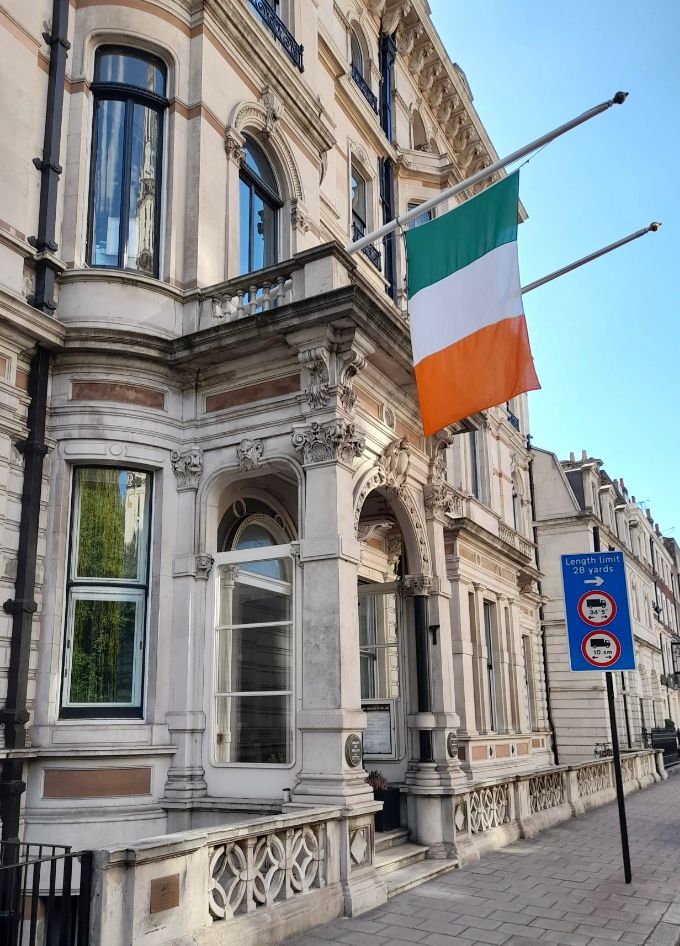
Specialist interior finishes at the Embassy of Ireland, London — commercial painting and decorating of occupied state rooms in a live building.
We carried out specialist interior finishes at the Embassy of Ireland, working inside an occupied building and keeping the appointment discreet.
Occupied diplomatic interiors in London are commercial painting and decorating with the building still in use — work we take across London and the South East.
We were appointed by the Embassy of Ireland to deliver specialist interior finishes in the embassy building. The works were internal. The building stayed in use. That combination — specialist decoration, in an occupied diplomatic interior — is the whole of the job, and it is enough.
An occupied embassy is not a vacant shell you can take over. People continue to work in the building. Circulation has to stay open. The finish has to suit the interior that is already there, not impose a site aesthetic on it. We were there to decorate with care, to work around the life of the building, and to leave the interiors looking as they should, without turning the appointment into a story about rooms or grades we were not asked to name.
We do not add a listed status, a room list or a public description of the interior to this record. The Embassy of Ireland appointed us for specialist interior finishes in an occupied building. That is the fact of the work. Discretion is part of the delivery, not a line we write around.
Working in an occupied embassy changes the shape of a decorating day. Access is granted, not assumed. Areas are released when they can be released. Tools, materials and waste move through the building without becoming a second occupation. We planned the work around those constraints rather than asking the building to become a site for our convenience.
Specialist interior finishes in this setting are judged on whether they belong. The decoration has to sit on the existing interior, match the standard the building already holds, and leave no trace of the process — no overspray, no dust in circulation, no smell lingering in rooms that are still in use. We used the methods the occupied interior required: contained work areas, protection of what was not being decorated, and a clean-down that left the space usable rather than closed.
We kept the team small enough to be quiet in the building and large enough to finish the released areas properly. That is the balance on occupied diplomatic work. Rush it and you leave a mark. Over-man it and you become the disruption. We stayed inside the appointment: internal finishes only, no invented external package, no claimed survey of the whole estate, no public inventory of the rooms we touched.
Discretion here is operational. We do not describe the interior in a way that turns a private appointment into a tour. We do not name rooms. We do not attach a listing grade we were not given. What we can say is that we decorated an occupied embassy interior to a specialist standard, that the building remained in use, and that the Embassy of Ireland received a finished interior rather than a site that still needed to be put back together.
This is the kind of work we take because we can decorate to a high standard without needing the building emptied. Occupied interiors at the Embassy of Ireland — that is the job.
We are CHAS and SSIP accredited and 100% RIDDOR-free.


We carried out specialist interior finishes at the Embassy of Ireland, working inside an occupied building and keeping the appointment discreet.
Occupied diplomatic interiors in London are commercial painting and decorating with the building still in use — work we take across London and the South East.
We were appointed by the Embassy of Ireland to deliver specialist interior finishes in the embassy building. The works were internal. The building stayed in use. That combination — specialist decoration, in an occupied diplomatic interior — is the whole of the job, and it is enough.
An occupied embassy is not a vacant shell you can take over. People continue to work in the building. Circulation has to stay open. The finish has to suit the interior that is already there, not impose a site aesthetic on it. We were there to decorate with care, to work around the life of the building, and to leave the interiors looking as they should, without turning the appointment into a story about rooms or grades we were not asked to name.
We do not add a listed status, a room list or a public description of the interior to this record. The Embassy of Ireland appointed us for specialist interior finishes in an occupied building. That is the fact of the work. Discretion is part of the delivery, not a line we write around.
Working in an occupied embassy changes the shape of a decorating day. Access is granted, not assumed. Areas are released when they can be released. Tools, materials and waste move through the building without becoming a second occupation. We planned the work around those constraints rather than asking the building to become a site for our convenience.
Specialist interior finishes in this setting are judged on whether they belong. The decoration has to sit on the existing interior, match the standard the building already holds, and leave no trace of the process — no overspray, no dust in circulation, no smell lingering in rooms that are still in use. We used the methods the occupied interior required: contained work areas, protection of what was not being decorated, and a clean-down that left the space usable rather than closed.
We kept the team small enough to be quiet in the building and large enough to finish the released areas properly. That is the balance on occupied diplomatic work. Rush it and you leave a mark. Over-man it and you become the disruption. We stayed inside the appointment: internal finishes only, no invented external package, no claimed survey of the whole estate, no public inventory of the rooms we touched.
Discretion here is operational. We do not describe the interior in a way that turns a private appointment into a tour. We do not name rooms. We do not attach a listing grade we were not given. What we can say is that we decorated an occupied embassy interior to a specialist standard, that the building remained in use, and that the Embassy of Ireland received a finished interior rather than a site that still needed to be put back together.
This is the kind of work we take because we can decorate to a high standard without needing the building emptied. Occupied interiors at the Embassy of Ireland — that is the job.
We are CHAS and SSIP accredited and 100% RIDDOR-free.


GSD London Ltd
Company Number: 10543768
VAT Number: 261280131
Head Office
40 Bowling Green Lane,
EC1R0NE, United Kingdom


